Who answers the order mail while I am at the oven?
Noor owns Corner Bakery. Offices and clubs mail her their orders, and the answers have to be quick, correct and in the shop's voice. She wants the order mail answered through the day, without standing at her laptop.
What it gives her: an order desk that runs by itself. Every order mail is answered by a role, checked by a second role before it goes out, and the one question only she can answer comes to her phone, with advice and a safe standard.
Part of all use cases. Corner Bakery and its people are made up; the screens are the real studio, in a demo studio.
The owner and her question
Corner Bakery bakes at night and sells in the morning. Between the two, orders come in by mail: forty sandwiches for Monday, a birthday cake for Saturday, a standing order for a club. Each one needs a look at the oven, a price from the price list, and a friendly, exact answer.
Noor does not want a shared inbox she has to watch, or a chain of tools she has to keep running. She wants a colleague for it, and she wants to stay the one who decides what matters.
How she set it up
She tells Claude what she wants, and makes the roles in the studio
Noor has her own Wantzel Studio, with Claude connected to it. She says what she wants; the roles themselves she makes in the studio, because only a person makes a role and writes its rules.
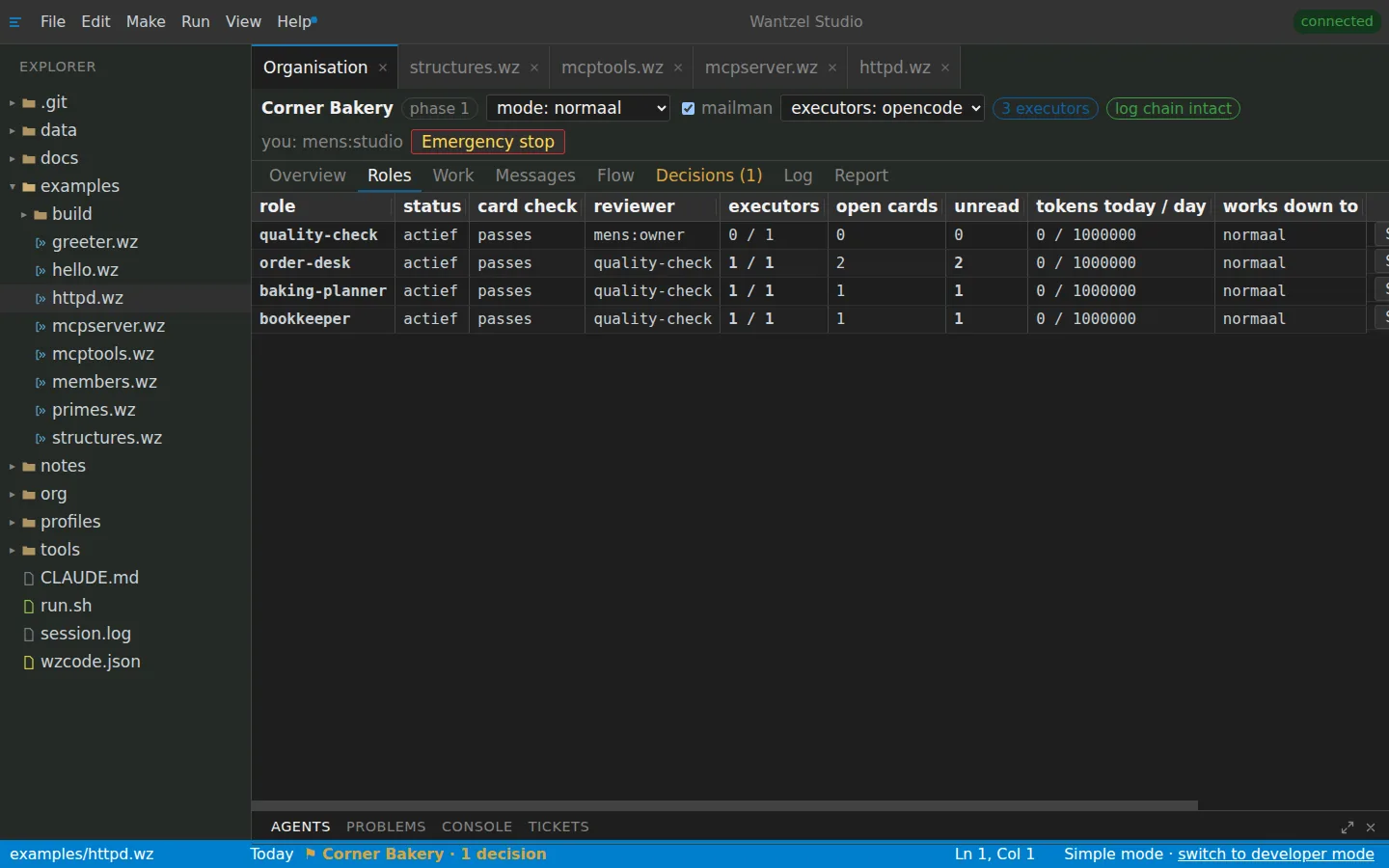
Organisation > RolesShe makes two roles from the catalogue, an order desk and a quality check, and reads the card of each: its goal, what it may do, what never, who reviews it and when it stops. A card works only when it is complete.The rules, in plain wordsOne rule a line, with who set it and why: "never promise a time the oven cannot keep", "never offer a discount". Every executor of the role reads them first and names the rule it applied.An address for the roleThe studio has an address for orders, and the order desk's card says that mail on it is its work. Every new mail is labelled for the role, and the role hears it without a model in between.Raise a roleFifty situations, one card each, on her phone or at her desk: how the order desk sounds, what it does in doubt, what it never says. The studio writes the role's DNA from her answers, and she can change it.Who reviewsThe order desk is reviewed by the quality check, and the quality check by Noor herself. A reviewer is never the role itself.
The roles
From then on, nothing for her to start
Mail comes in on the address, the order desk takes it, and the work moves between the roles as cards on a board. She does not hand out tasks and she does not watch the inbox; she answers the questions that come to her.
Step by step
-
A mail comes in
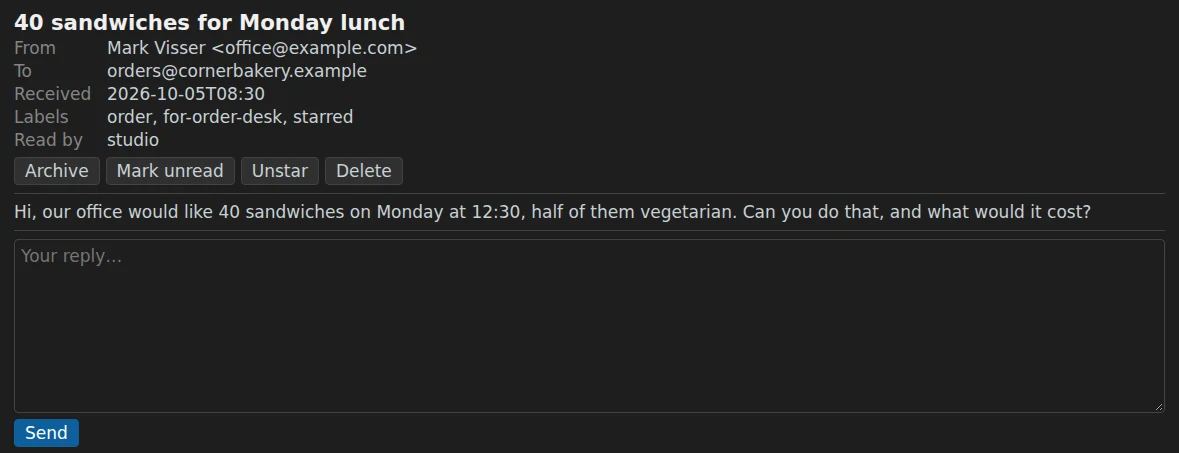
An office asks the bakery's order address for 40 sandwiches for Monday lunch, half of them vegetarian. The mail is sorted once: it is an order, and it is for the order desk.
One mail, sorted for a role
-
The order desk picks it up, the quality check looks along
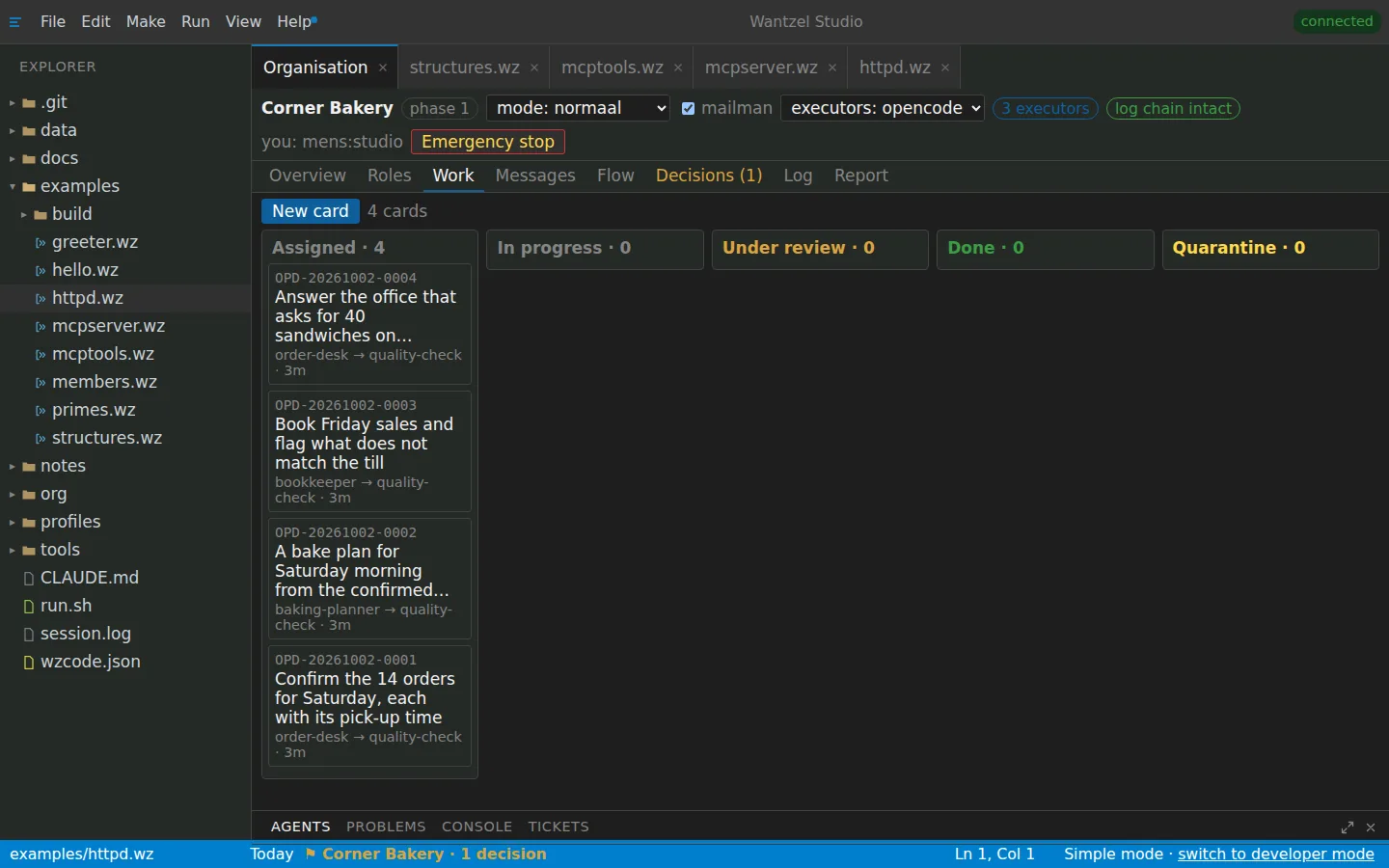
The mail becomes a card on the work board: the order desk answers it, and the quality check reviews the answer before it goes out.
The work board
-
One decision for the owner
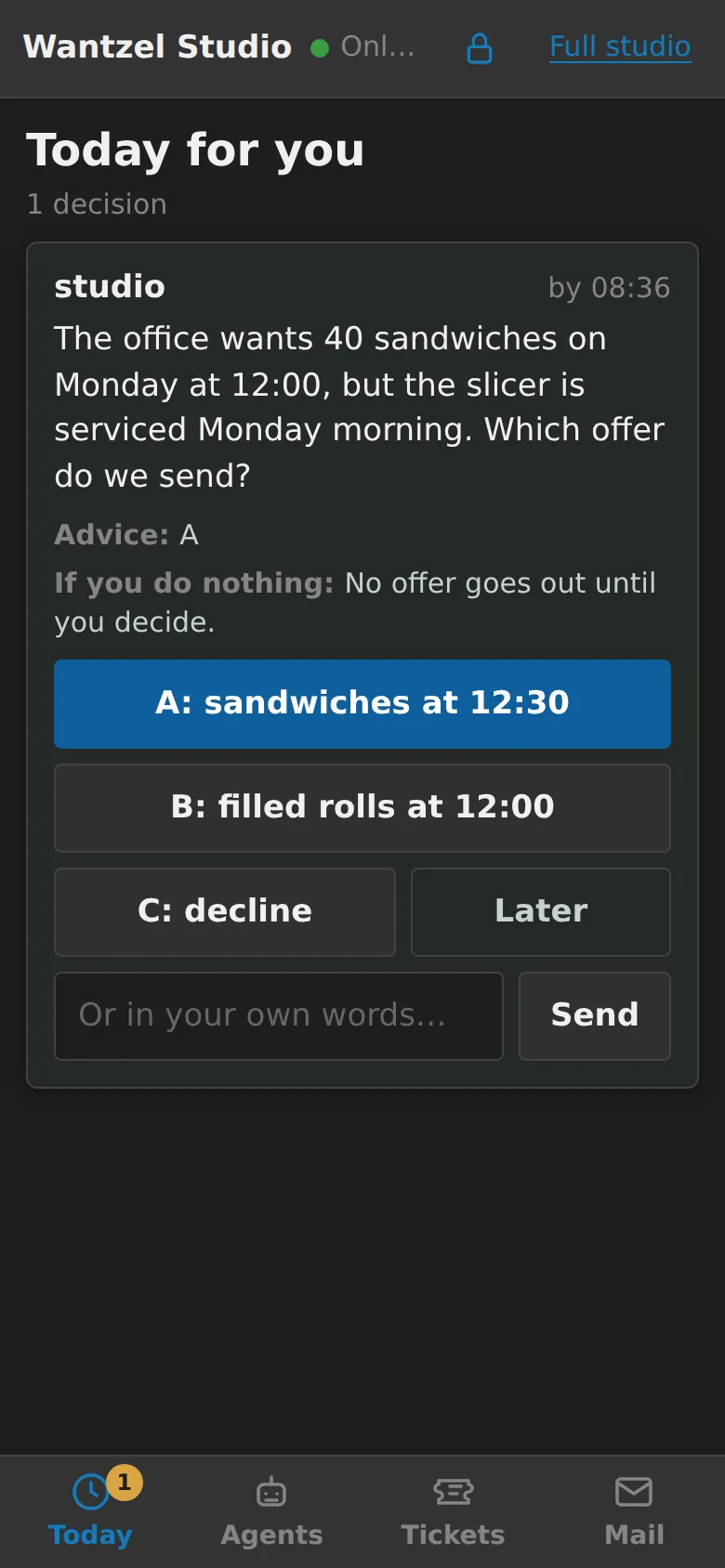
Then the office asks whether the sandwiches can be there at 8:00. The oven is full until 9:00, and baking the evening before would break the shop's promise of fresh bread. That is not the order desk's call. The owner gets the question with three answers, a recommendation (offer 9:30 with free coffee) and the reason, and with what happens if nobody decides in time: decline politely.
The decision
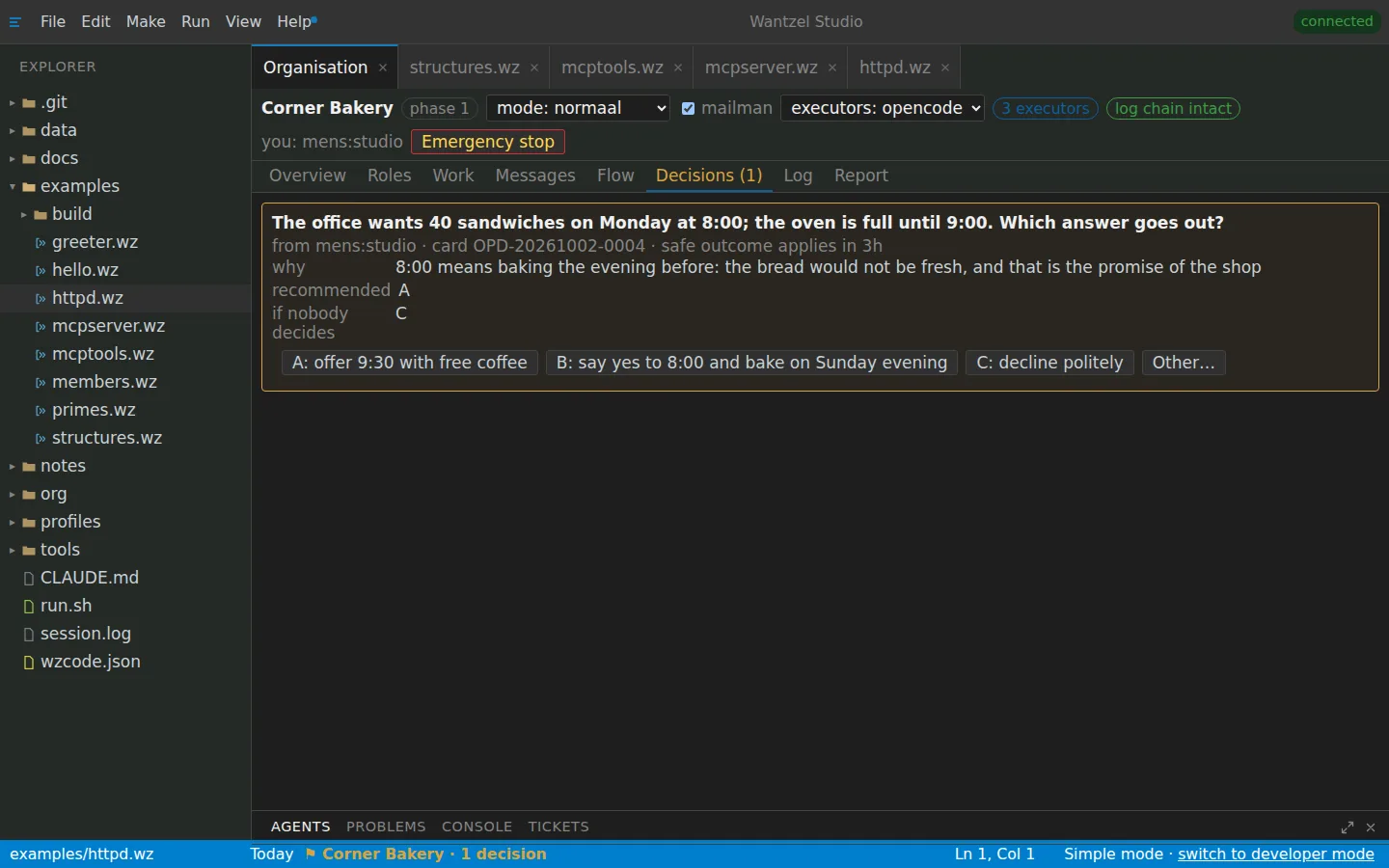
The owner chooses; the answer goes out in the same thread as the office's mail.
Why in the studio: an autonomous process
The order desk is not a mailbox with a chatbot on it. It is a process that runs by itself, from the first message to the finished work, with the limits built into the studio rather than left to a prompt.
- Every role does only what its card saysA call an agent makes is checked against its role card before it runs. What the card does not allow is refused and logged, so the order desk cannot promise a discount however it was asked.
- A second role looks before it goes outEvery answer is reviewed by a second role. What does not pass goes back, or into quarantine. A role never reviews its own work.
- Only the decision that matters comes to a personThe owner gets the question on her phone, with the options, a recommendation and the reason, and with the safe outcome if nobody decides in time. Questions come bundled in a daily window she chooses.
- Everything in a logEvery change is a record in the organisation's log, which is only ever added to and hash-chained: you see where it was touched. Each role also keeps its own record of tasks and outcomes.
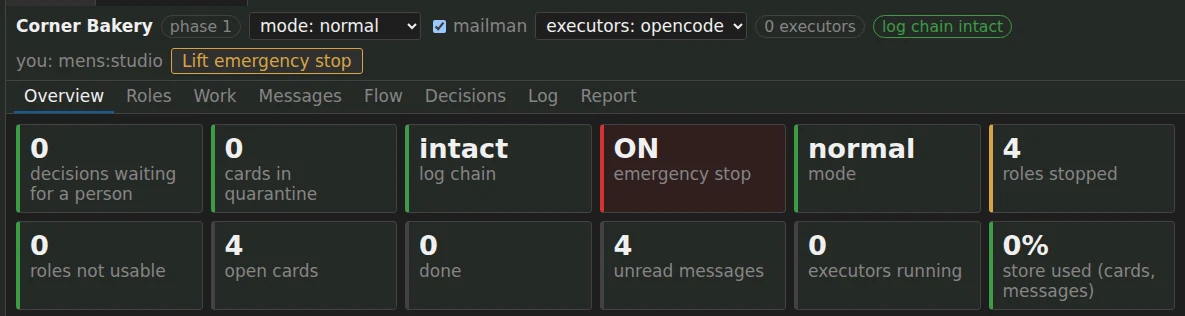
- One emergency stopOne button stops every running agent at once, or one role, one card, one agent. Only a person starts them again.
- Mail with mannersMail is data: an agent never does what a mail tells it to do. A first mail to someone who never wrote waits for the owner, every mail passes one check on the way out, and a mail from the studio says it was sent by an AI agent.
- Promises are tasksIf the order desk writes "I will confirm on Friday", that becomes a task with an owner and a term, and a passed term becomes a card for the owner.
- Everything in one studioMail, work board, decisions, agents and the AI models of your choice: Claude, Codex, Gemini and more, on your own accounts. If one hits a limit, the run goes on with another.
The emergency stop
Side by side: three years of the order desk
A small bakery with the owner and one helper who also answers mail. On the left as Noor did it: two living agents, the order desk and the quality check, a login for the helper, and the studio's own mail and work board. On the right as it usually goes: a shared inbox or helpdesk tool for two people, an automation tool that connects it, an AI service, and someone who sets it up and keeps it working.
| Wantzel AI Studio | The usual route | |
|---|---|---|
| Who sets it up | The owner, with ClaudeRoles from the catalogue, rules in plain words | A freelancer or agencyHours to buy, and again for every change |
| Shared inbox | IncludedThe studio's own mail, with a mailbox you can read along | EUR 696 a yearTwo seats at about EUR 29 a month |
| Automation between the tools | IncludedRoles, cards and reviews are the studio | EUR 204 a yearAbout EUR 17 a month |
| Studio and living agents | EUR 240 a yearEUR 20 a month, the helper joins for free; the two agents are on around the clock, 1,440 I/O credits a month, within the 2,000 included | – |
| Mails and tool calls | EUR 240 a year300 mails a month (150 orders, a mail in and an answer out) and 750 tool calls of the agents (5 per order, each one counts) come on top of the 1,440: 2,490 I/O credits, so a subscription of EUR 40 (4,000 I/O credits a month) | IncludedIn the price of the tools |
| AI | ≈ EUR 240 a yearYour own AI account | ≈ EUR 240 a yearAn AI service the tools call |
| Setting it up | EUR 0Built by the owner with Claude | EUR 4,000One-off: 40 hours at EUR 100 |
| Maintenance | EUR 0A change is a new question | EUR 600 a year15% of the setup, from year 2 |
| Parties | 1Plus your own AI account | 4Inbox tool, automation tool, AI service, whoever sets it up |
| Year 1 | EUR 720 | ≈ EUR 5,140 |
| Years 2 and 3 | EUR 720 a year | ≈ EUR 1,740 a year |
| Three years | EUR 2,160 | ≈ EUR 8,620 |
Excluding VAT, indicative, prices of 7 October 2026. The owner's own hours are in neither column. How we calculated, and the same sum for an owner on her own and for a team of five →
Where else you can use this pattern
A role that works by its card, a second role that reviews, and a person who decides the one thing that matters. It fits any process that arrives as a message and ends in an answer:
- Quote requestsA request for a visit or a job comes in; a role works out the price from the rates and the open slots, and the owner decides.
- Complaints and returnsA role answers by the book, a second role checks the tone, and anything about pain, anger or money becomes a card for a person.
- Supplier follow-upWhat a supplier promises is tracked as a promise with a term; when the term passes without an answer, a card says so.
- AppointmentsA role confirms, moves and reminds, within the hours on its card.
- Invoice remindersA role sends the friendly reminder on the term, and a customer who disputes it comes to the owner.
- ApplicationsA role answers every applicant politely and in time, and passes the promising ones to a person.
- Website changesA role proposes a change as a draft, a second role checks it, and nothing goes live without approval.
- Course materialA role turns what the organisation knows into a self-study course, and the owner approves the bundle.
Read next
Your own work, run by AI colleagues
EUR 20 a month, cancel any time
Sign up with your email address. After the checkout your studio is set up, and you start right away.