Does this week's till add up with the books?
Noor owns Corner Bakery. Every Friday she wants to know whether what the till took matches what the books say, and she does not want to spend her Friday evening finding out.
What it gives her: a bookkeeper role that does the week by itself every Friday, a second role that checks the bookings before they count, and a short list of the lines that do not match, with the one question that needs her.
Part of all use cases. Corner Bakery and its people are made up; the screens are the real studio, in a demo studio.
The owner and her question
The bakery takes money at the till all week: cash, cards, orders paid in advance. Every Friday the sales of the week have to be booked, and every line that does not match the till has to be found: a refund that was not booked, a card payment booked twice, an order paid but never rung up.
Noor already has a bookkeeping package, and it stays. What she wants is the weekly work around it done by a colleague: the matching, the bookings, the list of differences. And she wants every number to be checked by someone other than the one who made it.
How she set it up
She describes the week, and makes two roles in the studio
She tells Claude what the Friday round is. The roles she makes in the studio herself, because only a person makes a role and sets what it may do.
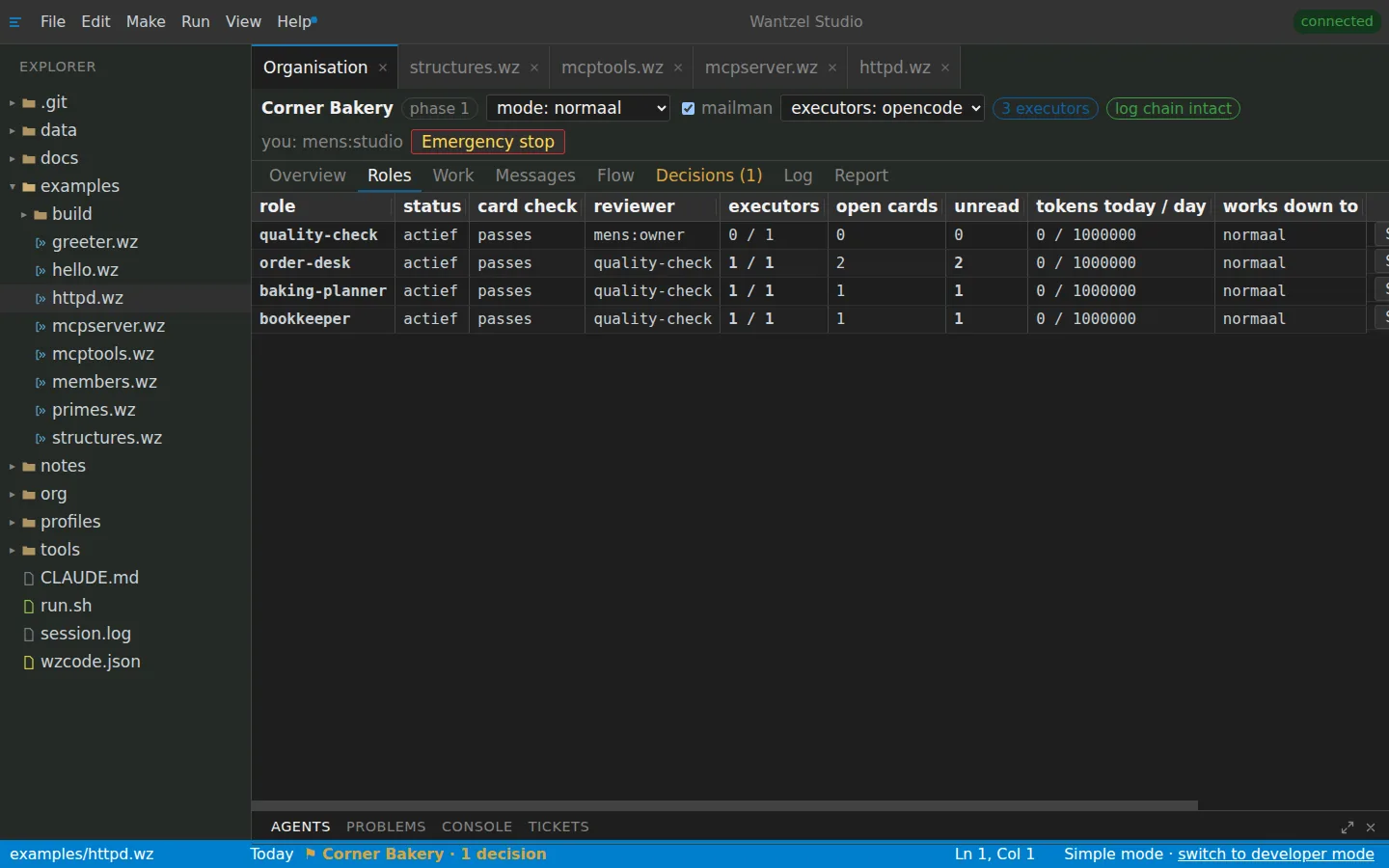
Organisation > RolesShe makes a bookkeeper from the finance role of the catalogue and a quality check from the review role. The bookkeeper's card says what it may read (the till export and the bank lines), what it may write (bookings and the list of differences), and what never (paying, writing to anyone outside, changing a week that was already approved).The rules, in plain wordsA threshold for a difference that is only noted, an amount above which it always goes to Noor, the booking rules of the shop. The bookkeeper reads them first and names the rule it applied.Who reviewsThe bookkeeper is reviewed by the quality check, and the quality check by Noor. The reviewer is never the role itself, and a card without a reviewer does not work.Run > ScheduleA weekly schedule, every Friday at a time she chooses, runs a small program that prepares the week, also when the studio is closed. The week's card for the bookkeeper is on the board with its deadline and the evidence the reviewer will see.A budget per roleThe bookkeeper has a budget per card and per day. When it is used up the role stops, and the studio shows what each role used today.
The roles
From then on, Friday is not hers
The week's card is on the board, the bookkeeper takes it, the quality check reviews it, and Noor hears about it only when something does not add up.
Step by step
-
A task for the bookkeeper
Every Friday, the bookkeeper role books the week's sales and flags every line that does not match the till. It works within its role card: what it may change, and what never.
The work board
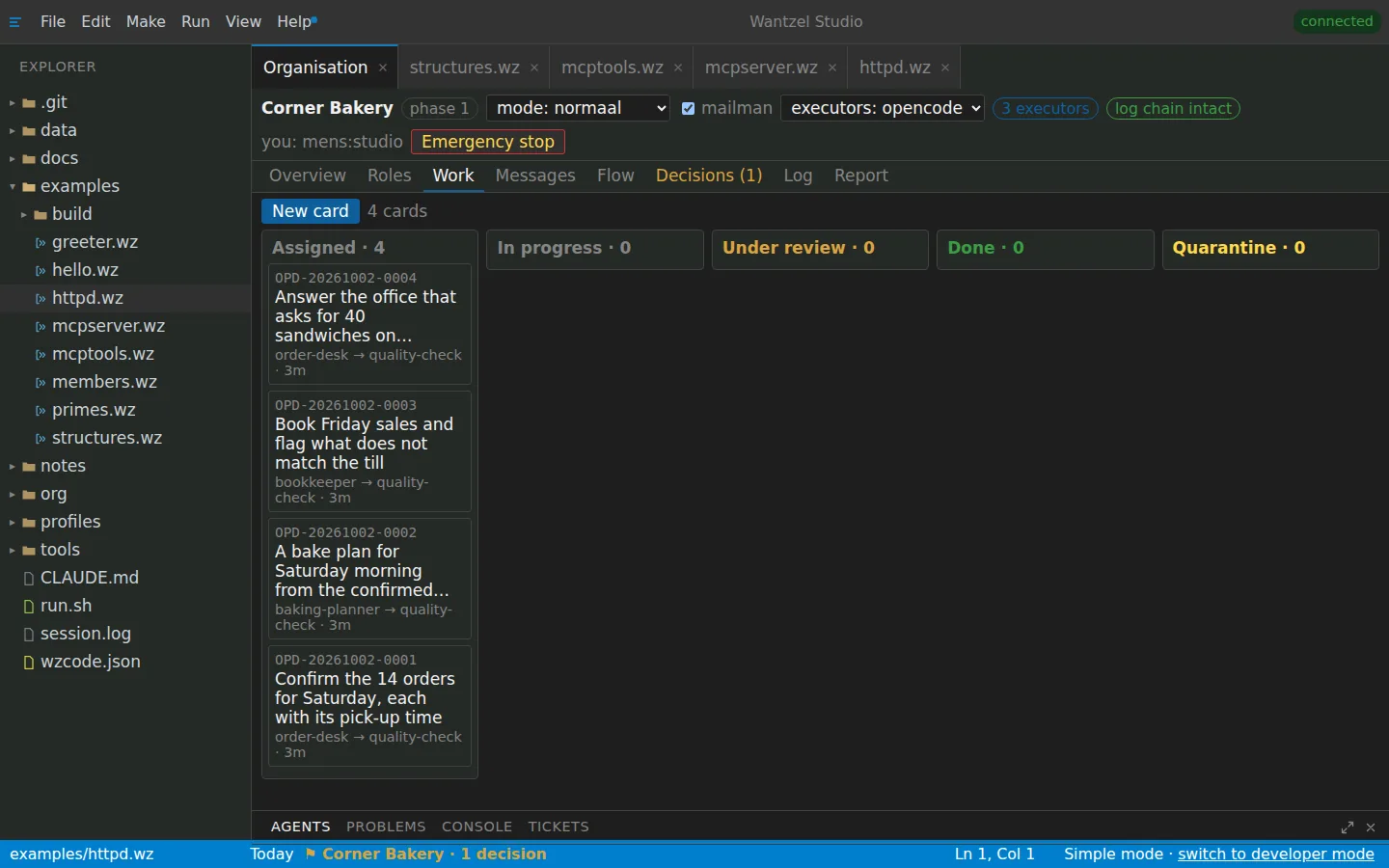
The week's card: the bookkeeper does it, the quality check reviews it. -
Reviewed before it counts
The quality check reviews the bookings before the card counts as done. What does not add up goes back, or into quarantine, and a difference only a person can explain becomes a question for the owner.
Messages between the roles
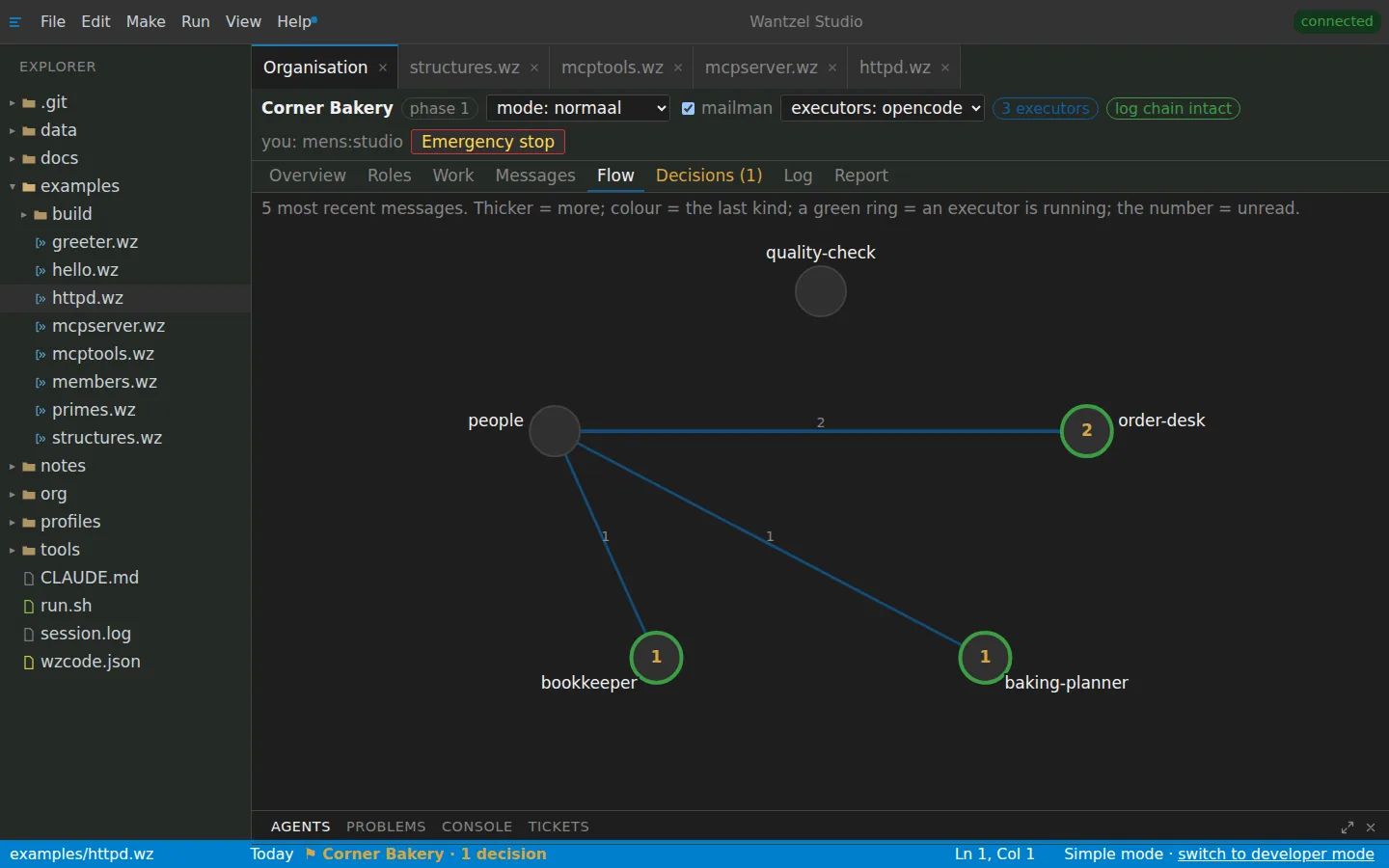
Who wrote to whom, this week. -
Visible all the way
Every step is in the organisation's log. The owner sees on Today what was done and what waits, and what each role used today.
Why in the studio: an autonomous process
The weekly books is not a mailbox with a chatbot on it. It is a process that runs by itself, from the first message to the finished work, with the limits built into the studio rather than left to a prompt.
- Every role does only what its card saysA call an agent makes is checked against its role card before it runs. What the card does not allow is refused and logged, so the bookkeeper cannot pay a bill or change an approved week, however it was asked.
- A second role looks before it goes outThe bookkeeper's work is reviewed by a second role. What does not pass goes back, or into quarantine. A role never reviews its own work.
- Only the decision that matters comes to a personThe owner gets the question on her phone, with the options, a recommendation and the reason, and with the safe outcome if nobody decides in time. Questions come bundled in a daily window she chooses.
- Everything in a logEvery change is a record in the organisation's log, which is only ever added to and hash-chained: you see where it was touched. Each role also keeps its own record of tasks and outcomes.
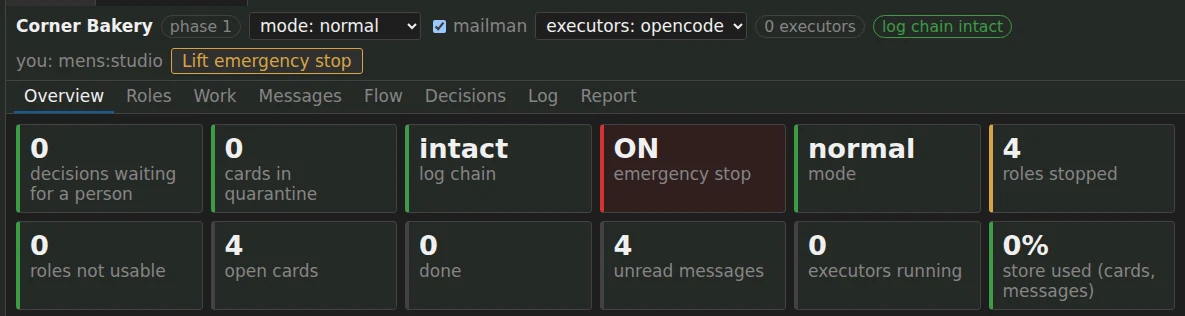
- One emergency stopOne button stops every running agent at once, or one role, one card, one agent. Only a person starts them again.
- Rules you can read on one pageOrganization > Rules lists every rule that holds in the studio: what each role may and never does, with where it stands and what it held back in the last 30 days.
- Everything in one studioMail, work board, decisions, agents and the AI models of your choice: Claude, Codex, Gemini and more, on your own accounts. If one hits a limit, the run goes on with another.
The emergency stop
Side by side: three years of the weekly books
The same small bakery. The bookkeeping package stays in both columns. On the left as Noor did it: a bookkeeper and a quality check as living agents. On the right as it usually goes: an automation tool that moves the exports, an AI service that does the matching, and someone who sets it up and keeps it working.
| Wantzel AI Studio | The usual route | |
|---|---|---|
| Who sets it up | The owner, with ClaudeRoles from the catalogue, rules in plain words | A freelancer or agencyHours to buy, and again for every change |
| Bookkeeping package | EUR 276 a yearStays as it is, about EUR 23 a month | EUR 276 a yearThe same package |
| Automation between the tools | IncludedThe weekly schedule and the work board are the studio | EUR 204 a yearAbout EUR 17 a month |
| Studio and living agents | EUR 240 a yearEUR 20 a month; the two agents are on for the weekly round, about 18 hours and 607 tool calls, 625 I/O credits a month, within the 2,000 included | – |
| AI | ≈ EUR 240 a yearYour own AI account | ≈ EUR 240 a yearAn AI service the tools call |
| Setting it up | EUR 0Built by the owner with Claude | EUR 5,000One-off: 50 hours at EUR 100 |
| Maintenance | EUR 0A change is a new question | EUR 750 a year15% of the setup, from year 2 |
| Parties | 2The package, plus your own AI account | 4Package, automation tool, AI service, whoever sets it up |
| Year 1 | EUR 756 | ≈ EUR 5,720 |
| Years 2 and 3 | EUR 756 a year | ≈ EUR 1,470 a year |
| Three years | EUR 2,268 | ≈ EUR 8,660 |
Excluding VAT, indicative, prices of 7 October 2026. The owner's own hours are in neither column. How we calculated, and the same sum for other packages →
Where else you can use this pattern
A role that does a regular piece of work on its card, a second role that checks it, and a person who answers only what is left. It fits any weekly or monthly round:
- Month-end checksA role compares the month's figures with the sources and lists what differs; a second role checks the list.
- Stock and baking planA role turns confirmed orders into the plan for Saturday, and a second role checks it against the oven.
- Payment remindersEach Friday a role sends the friendly reminder on terms that passed, and a dispute comes to the owner.
- Supplier invoicesA role matches each invoice with the order it belongs to and flags the ones without.
- Opening hours and prices onlineA role keeps the website in step with the price list as a draft; a second role checks it before it goes live.
- Weekly reportA role writes the owner's weekly overview from the board and the log, in plain words.
Read next
Your own work, run by AI colleagues
EUR 20 a month, cancel any time
Sign up with your email address. After the checkout your studio is set up, and you start right away.